h

Dar Bellarj

Ch[a]rita / السِّيس 2018

Artistic interventions, screenings & conversations in Marrakech

Ch[a]rita 2018 was the inaugural edition of a multidisciplinary artistic program that explored the relationship between public space, collective memory, urban heritage, and contemporary artistic practices in Marrakech. Through performances, screenings, discussions, installations, and participatory projects, the program invited audiences to experience the city as a space of encounter, imagination, and shared narratives.

Ch[a]rita 2018 marked the beginning of a long-term artistic and cultural initiative dedicated to examining public space as a site of collective memory, social interaction, and cultural production. Conceived by Madrassa Collective in collaboration with local and international partners, the program unfolded across multiple locations in Marrakech, including public squares, historic neighborhoods, cultural spaces, and community sites. The inaugural edition brought together artists, filmmakers, researchers, performers, architects, and cultural practitioners whose work engaged with questions of urban transformation, heritage, migration, memory, gender, and social belonging. Through a rich program of screenings, performances, public discussions, workshops, installations, and site-specific interventions, participants were invited to reconsider how public spaces are experienced, shared, represented, and contested. A central concern of the edition was the relationship between the city and its inhabitants. The projects explored how collective memories inhabit streets, markets, squares, and neighborhoods, while also examining the tensions created by tourism, urban development, heritage policies, and social change. By activating locations such as Jemaa el-Fna, the Medina, Souk El Ghzel, and other everyday urban environments, the program transformed familiar places into temporary platforms for dialogue and artistic experimentation. Through encounters between local communities, artists, and audiences, Ch[a]rita 2018 proposed new ways of engaging with the city. It emphasized the importance of public space as a shared cultural resource and affirmed the role of artistic practice in creating spaces for reflection, participation, and collective imagination.
Ch[a]rita 2018The first edition of Ch[a]rita emerged as an experimental platform dedicated to exploring the intersections between art, public space, memory, and urban life. Conceived as a series of artistic interventions and public encounters throughout Marrakech, the program sought to create opportunities for dialogue between artists, researchers, cultural practitioners, and local communities. Taking place across diverse sites within the city, Ch[a]rita transformed streets, squares, cultural venues, and historical locations into temporary spaces for artistic production and collective reflection. The program included film screenings, performances, public discussions, sound-based projects, installations, workshops, and participatory actions that encouraged audiences to engage actively with their urban environment. Many of the invited projects addressed questions of heritage, urban transformation, migration, memory, and social belonging. Artists examined how cities are shaped by visible and invisible histories, exploring the ways in which public spaces become repositories of collective experiences. Through investigations into architecture, oral history, popular culture, tourism, and everyday practices, participants highlighted the complex relationship between contemporary urban realities and inherited cultural narratives. Particular attention was given to the city of Marrakech itself. Public spaces such as Jemaa el-Fna, the Medina, and other historically significant locations became active sites of artistic inquiry. These interventions encouraged audiences to question dominant representations of the city while rediscovering overlooked stories, practices, and forms of knowledge embedded within its urban fabric. By bringing together diverse artistic voices and creating opportunities for public participation, Ch[a]rita 2018 established a framework for future editions. It demonstrated how artistic practice can contribute to critical reflection on the city and foster new forms of engagement with public space, collective memory, and shared cultural heritage.

Dig into Ch[a]rita’s artistic interventions

Ancestral footsteps is a performative ephemeral installation in souk Laghzel, one of the historical slave markets of the city of Marrakech, now converted in a women-led second-hand clothing one. 

As a journey traversing times, places, voices and voids, the piece explores, through visual and sonic overlaps and crossovers, the silenced history of slavery in Morocco and the contemporary racialised conditions of sub-Saharan African women migrants in Morocco. 

The spatial and visual configuration of the square, its cumulation of second-hand clothes, traces of transient statuses of ownership, of invisible or absent bodies, does not only evoke the passage and trading of enslaved subjects through time, but denounces also the competing appropriation over, or inaccessibility to archives, memories, histories and images. 

  •  Mahassine El Hachadi / Based in Marrakech, El Hachadi is a film-maker. She has been writing and directing several short fictions and documentaries.

Cabaret  is an ongoing research project by Firas Hamdan aimed at questioning spatial relations and divisions within the changing dynamics

of the urban fabric in major Arab cities, where art production in spaces such as cabarets or theaters negotiates inclusivity and connection to its

surroundings. Challenging cultural stigmas, the research utilises archival material collected from literature, theater, films, commercials and TV shows, to articulate the social dimensions of public space, spotlight and representation in the media. Cabaret is a series of shows in the form of live DJ performances, film screenings and public talks started last year as part of Bazar, a programme curated by Madrassa Collective.

While part of the discursive programme was presented at LE 18, Cabaret  was activated as Cabaret 7wai in the now demolished and iconic Gueliz’s Cabaret 7Heaven. A research based remix of tunes that made people dance since the middle of the past century for decades, Cabaret 7awi recalls collective memories to the dance floor and orchestrates Tarab ambiance preferably associated with alcohol, cigarette smoke and red lights.

  • Firas Hamdan / Based in Amman, Hamdan is a researcher focused on urban dynamics, identity, music and collective memory.

Moving from collected narrations and field recordings, Herder proposes a sonic guided tour in the medina reactivating collective and intimate spaces of remembrance of the medina that used to be. 

The tour is nourished by the description by ancient inhabitants of their neighbourhood, houses and cafés, by soundscapes capturing habitats of social practices that have been displaced from the medina to other districts of Marrakech. Navigating between displacement and replacement, layers of time intermingle. 

Present and past, reality and fiction superimpose, asking what happens if the declaration of places as a world heritage expulses the social spaces that formerly coexisted with the architectonic space.

  • Eleonora Herder / Working between Frankfurt Main, Barcelona, Berlin and Warsaw, Herder is a dramaturg focusing on city political topics through performance and installation.

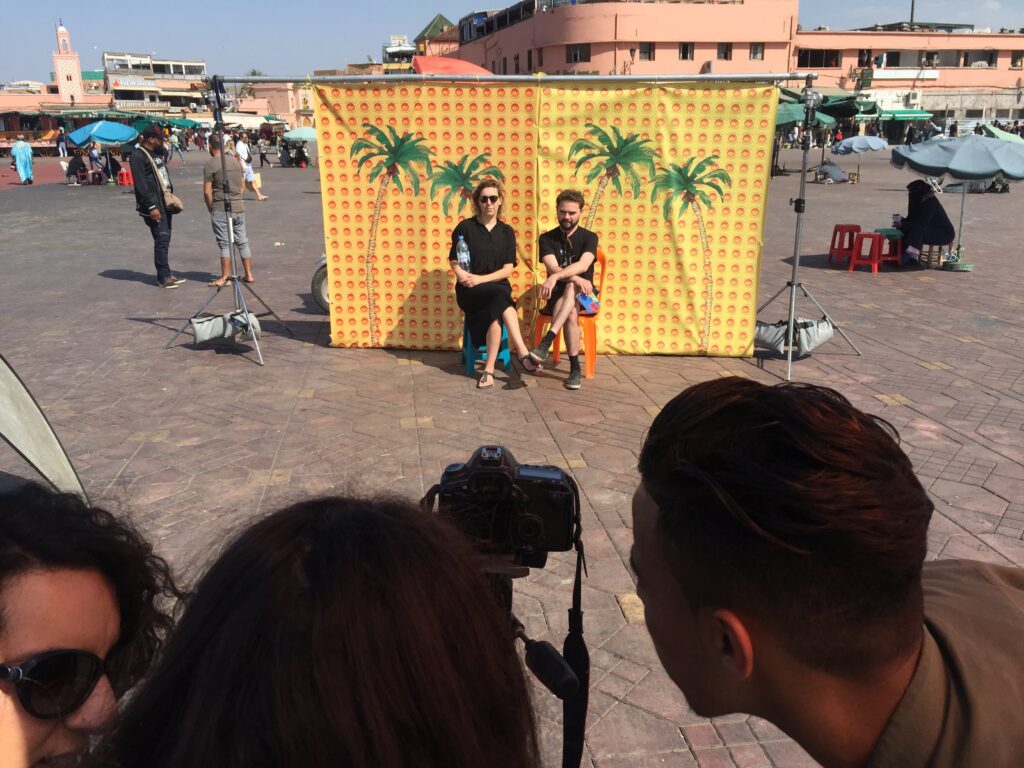
Adopting the aesthetic features of a traditional halqah, Arnakech is a pop-up photographic studio installing itself in the earth of Jemaa el Fna to offer tourists the possibility to portrait themselves in the

most symbolic, and exoticised, square of the city. 

Developed with the complicity of the association Ana Kanbghi Jemaa el Fna, Arnakech aims at inverting the power relations linked to photographic and portraying practices, while also playfully questioning the presence of strange[r] bodies, and the dominant Western canons recognized and demanded for the so-called African studio photography.

An archive of the project can be found here: https://www.instagram.com/arnakech_project/ Laila Hida / Based in Marrakech, Hida is a photographer exploring the tensions between the narrative potential of the camera and the selective nature of memory. 

  • Laila Hida is the founder of LE 18.

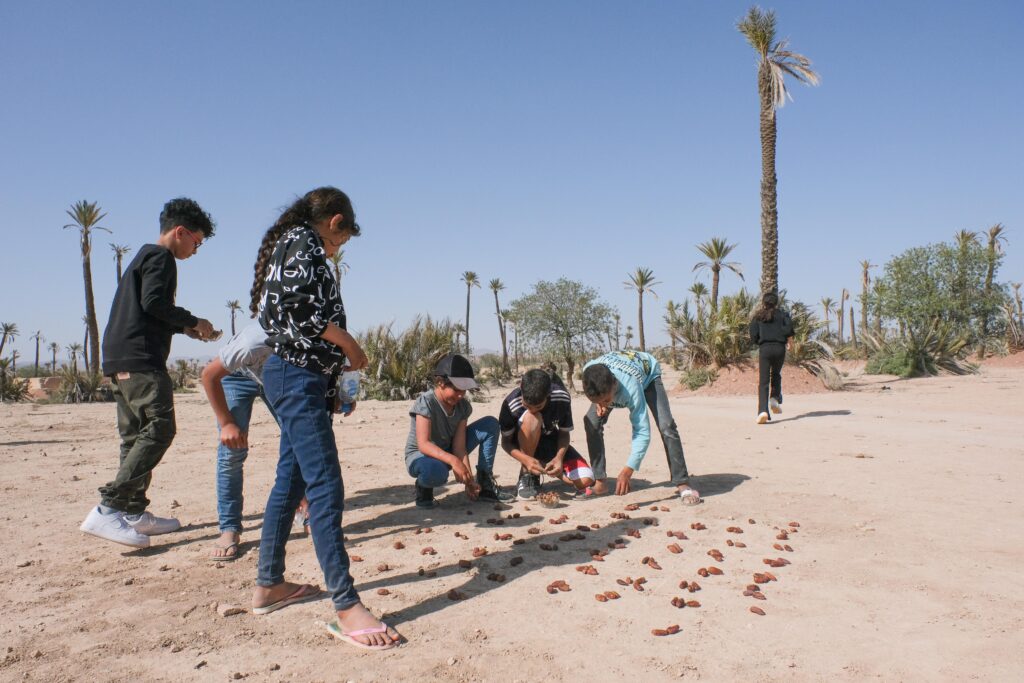
Traditionally, in the medina, when people need help, they usually knock on each other’s doors and ask for support. This social practice of proximate solidarity is nonetheless gradually disappearing, as the social tissue in the medina has deteriorated and many inhabitants have moved out of it. 

Through a performative workshop transforming into a public installation, Ouhnni proposes to appropriate and reenact this process of sharing with the inhabitants of LE 18’s neighborhood, derb el ferrane. Collecting photos and daily life basic goods such as tea, coffee, cereals, sugar and salt, the participative installation represents the living ingredients nourishing the medina.

  • Rachid Ouhni / Based in Marrakech, Ouhni is an artist exploring marginal, disappearing subjects, while developing a situated, local language.

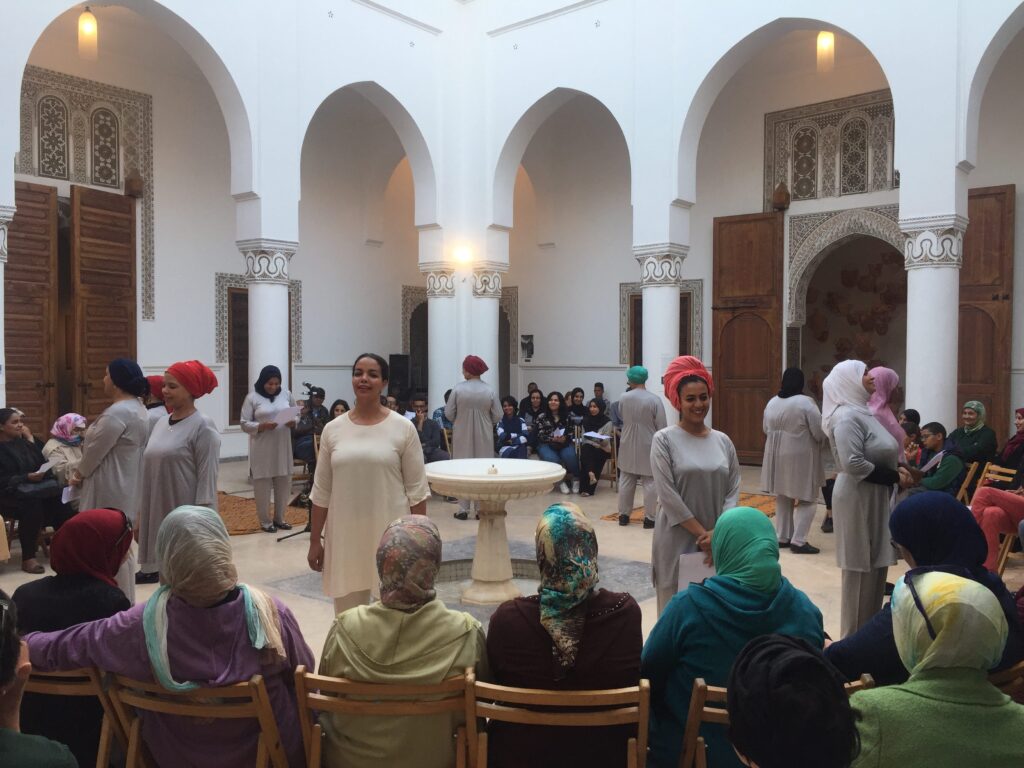
Vulnerabilité is a collaborative, semi-comic lecture-performance, and a quasi-biographical, critical reflection on feminism, socialization in patriarchal social structures and personal emancipatory processes. 

The artist unveils women’s body as a battlefield, as both a (seductive) weapon and a fragile space, playing with contradictory terms, from ironic and burlesque elements to tragic ones. Born as a solo piece in response to the current European anti-racist and feminized asylum discourse, this new episode is developed with the mediation of Maha Elmadi and with the Mamans of Dar Bellarj in Marrakech, drawing from their memories and imaginaries. 

Vulnerabilité therefore enacts multilayered processes of subjective appropriation and translation from woman to woman, from place to place, from institute to institute.

Ülkü Süngün / Based in Stuttgart, Süngün’s conceptual multidisciplinary work investigates identity, gender relations, language, migration and the politics of remembrance.